As we get closer to the start of the 2026 OSF season, I find myself doing one last look back at the previous season to bid it one final adieu to you…and you and you and you. But let’s not distract ourselves with the sound of music that will soon be coming from Ashland, primarily because the musical being put up is Come From Away.
Instead, I find it almost poetic that we should begin one season in the middle of March and officially bring an end to the 2025 season in a similar fashion to the demise of Julius Caesar as it was depicted during the 2025 season. And rightfully so! I mean, why should Caesar get to stomp around like a giant while the rest of us try not to get smooshed under his big feet?

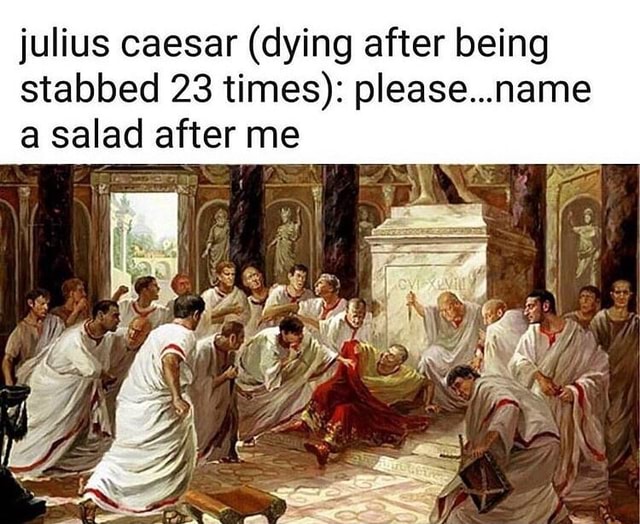
However, this train of thought got me to thinking…what exactly are the Ides of March? I know it’s the 15th, but why that date? Is it truly an ominous date that should be heeded because of misfortune, or has it become a thing due to pop culture? Why were Caesar’s final words asking that a salad be named after him? (OK, that last question was asked in jest, but seriously, I am curious.)
So, let’s dig a little deeper into this subject and see what the big Ide-a is!
So first up, what even is meant by an Ide? Well, believe it or not, the calendar looked a little different back in those BCE days. Back then, the days of each month were counted based on three different types of days. First were the “Kalends,” which marked the start of a new month and corresponded with the new moon. Next would be the “Nones,” which would happen usually on the fifth or seventh day of the month, depending on how long the month was. This would correspond with the first quarter moon and usually would be about 8 days before the fated Ides. If you noticed the trend of the days corresponding to the phases of the moon, then you probably can guess what day the Ides fell on. If you guessed the full moon, then congratulations you’re right! The Ides also would signify the middle of each month, either falling on the 13th or the 15th, and was named based off the word iduare, which means to divide in Latin, and this day divided the month into two. I feel like the Romans had something against the waning phase because I didn’t see any name for the three quarters moon, but maybe they chose to look at the moon as half full and not half empty.
Additionally, in that time, March was considered the first month of the year, so this being the first full moon had a deeper significance. According to Britannica, this meant it was a notable day to settle debts, and I guess Brutus had a big score to settle this new year, eh? However, because this was just a signifier for the middle of the month, it didn’t really spell doom for anyone outright. I mean, a full moon could be to blame for the wild actions that led to the fateful stabbing, or maybe Mercury was in retrograde or something, but the Ides did nothing wrong.
But that hasn’t stopped people from taking that ominous warning of betrayal and using it in their own works. Here are a few that I have found that feature this day in a significant way.
Okay this might be the most on-the-nose use of the misfortune brought on the day, as it itself could be considered an allegory to the murder of Caesar himself. Though in this instance it is a lot less actual stabbing and more metaphorical backstabbing and betrayal of politicians.
Keeping with the Greco-Roman theme, we naturally must talk about the icon, the legend and the moment, Xena. In season four, there is an episode that features this date…quite literally. In this episode, Caesar himself is conspiring with a demon to try and capture Xena, using Gabriella as bait. You’ll never guess what happens next…
Towards the end of this 90s drama TV show, we see another episode with the title Ides of March. Though there isn’t any stabbing (at least from what I can see online through synopses), there are some off screen deaths and betrayals and James Marsden before his character was recast for season 2. I mean…what else could you want!
In this story by Thorton Wilder, we zoom out a bit and look less at the day itself, but rather the stories that lead to the fateful stabbing. While maybe not the most historically accurate, it still is interesting to see how the puzzle all fits into place as you zoom out further and ultimately understand each character’s perspective.
While less focused on the day itself, in this Coen Film we see misfortune that follows a movie within the movie, aptly also called Hail, Caesar. Much like how the events that transpired on that day, there are folks who are trying to assassinate movie stars, but by releasing gossip stories that would assassinate their character! Can a Hollywood “fixer” help prevent this or will it end with another “Et Tu”?
So, there you have it, the truth behind what the ides are and how the theme of settling debts/scores with people still carries true to this day. While I’ll admit it may not be as ominous and haunting of a day as, say, Friday the 13th, hopefully we all heed the warning and remain wary of the Ides of March. The only thing I want now…is to figure out why he wanted a salad – of all things – named after him. Oh well…somethings we may never know.